CUPAL bimetallic washers (Cu/Al)
Copper-aluminium bimetal washers, M6 to M20, 11 sizes in stock from HUF 412 net. They stop galvanic corrosion in bolted Cu/Al joints.
CUPAL® washers (net, HUF)
| Bolt size | Outer dia. | Max. lug | SKU | Net list price | Quantity (pcs) |
|---|---|---|---|---|---|
| M6 | 16 mm | 120 mm² | ICALCU6CS | 437 HUF~ €1.18 | |
| M8 | 18 mm | 120 mm² | ICALCU8CS | 412 HUF~ €1.12 | |
| M10 | 23 mm | 240 mm² | ICALCU10CS | 677 HUF~ €1.83 | |
| M10 (large) | 26 mm | 300 mm² | ICALCU10CS2 | 759 HUF~ €2.05 | |
| M12 | 26 mm | 240 mm² | ICALCU12CS2 | 801 HUF~ €2.17 | |
| M12 (large) | 30 mm | 400 mm² | ICALCU12CS | 1,131 HUF~ €3.06 | |
| M12 (extra) | 46 mm | 500 mm² | ICALCU12CS3 | 2,357 HUF~ €6.38 | |
| M16 | 35 mm | 500 mm² | ICALCU16CS | 1,234 HUF~ €3.34 | |
| M16 (large) | 46 mm | 630 mm² | ICALCU16CS2 | 2,357 HUF~ €6.38 | |
| M20 | 37 mm | 500 mm² | ICALCU20CS | 1,768 HUF~ €4.79 | |
| M20 (large) | 46 mm | 630 mm² | ICALCU20CS2 | 2,357 HUF~ €6.38 |
Stock items: 2–10 working days from order to delivery.
Not the size you need?
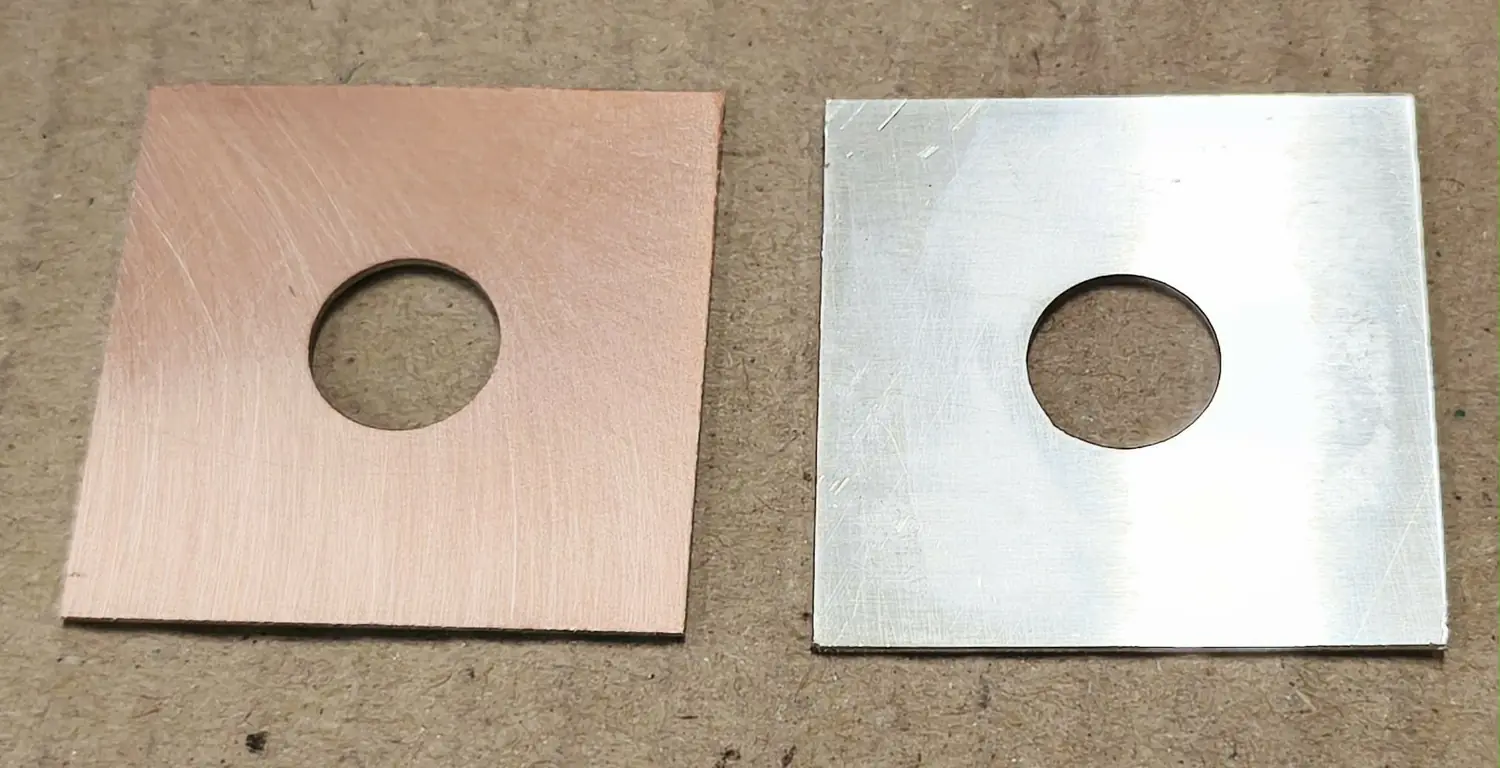
We also supply washers with your own outer and inner diameter, hole pattern or thickness, cut from CUPAL sheet, from a single 500 × 500 mm board. Quote within 24 hours, production in 5–10 working days.
Custom parts from your drawing →Cross-reference: distributor designations
| Distributor designation | Bore / outer / thickness | Our size | Our SKU |
|---|---|---|---|
| NEXANS Cupal M 8 Al-Cu | 8 / 18 / 1 mm | M8 | ICALCU8CS |
| NEXANS Cupal M 10 Al-Cu | 11 / 23 / 2 mm | M10 | ICALCU10CS |
| NEXANS Cupal M 12 Al-Cu | 13 / 28 / 2 mm | M12 or M12 (large) | ICALCU12CS2 / ICALCU12CS |
Which of our CUPAL washers matches the designation used by other distributors.
Mapped by bolt size and nearest outer diameter. Check the outer diameter against your lug footprint before ordering. M16, M20 and the large variants have no distributor equivalent listed here, but all of them are in the price table above at a net list price.
Also sold as a transition washer or bimetallic washer
If a specification, an earthing drawing or a bill of materials calls for a transition washer between an aluminium conductor and a copper lug or busbar, these are the parts that meet it. Earthing and substation suppliers usually call this part a transition washer or a bimetallic washer; cable-lug catalogues list it as an Al/Cu washer or a copper-aluminium transition washer. All these names describe the same part: a roll-bonded copper-aluminium disc that sits in a bolted joint so that each conductor touches only its own metal. The name transition washer is also used for a different part: profiled copper-alloy washers, whose raised pattern bites through the aluminium oxide film when the bolt is tightened. Those are solid copper alloy, not a bimetal, and the transition is only made when the joint is tightened. Ours is roll-bonded across the whole disc, so the transition is built into the part. Bimetallic connector is a looser term still: where that line on a drawing means a disc, this is the part; where it means a crimpable transition piece with an aluminium barrel and a copper palm, that is our CUPAL cable-lug range. Requirements for joints between dissimilar metals are set by IEC 61238 for cable connectors and IEC 61439 for low-voltage switchgear. Both apply to the installation the washer is fitted into, not to the CUPAL material itself.
If the specification only says "transition washer", first check which of the two parts it means: bimetallic or toothed transition washer — how to tell them apart. The CUPAL washer size guide walks through the choice by bolt size and lug cross-section, and What is CUPAL? explains the material itself.
The cladding ratio, and why it is worth checking
Not every copper-aluminium washer on the market is the same material. Ours is 70 % aluminium / 30 % copper by layer thickness, density 4.6 g/cm³, conductivity about 41.9 m/(Ω·mm²), which is the usual European specification. Others differ considerably: some washers are as lean as 15 % copper, and some sheet is supplied at a 1:1 ratio, which is roughly 5.8 g/cm³ and carries around two-thirds more copper. More copper means more conductivity per unit area and more weight and cost; less copper means the opposite. Neither is better in the abstract. It depends on whether the joint carries load current or is an earthing and bonding path where the bolt size sets the contact area. What matters is knowing which one you are buying. Many suppliers publish no ratio at all, which makes it impossible to specify against a drawing. If your specification calls for a particular ratio or a minimum copper thickness, tell us and we will confirm before you order.
Our list prices are published, net of VAT. An EN 10204 material certificate comes with every shipment (2.2 as standard, 3.1 on request), and we also supply parts made to your drawing.
Prices are net list prices. Gross = net × 1.27 (27 % Hungarian VAT applies to HU-issued invoices).Volume discounts from 200 pcs: ask for a quote.
Effective: 2026-07-20
In short
The CUPAL washer is a copper-aluminium bimetal transition washer, M6 to M20, that prevents galvanic corrosion at the contact faces of bolted copper-aluminium joints. Its copper face meets the copper cable lug and its aluminium face the aluminium busbar, so like metal touches like metal and the transition does not depend on a paste. It ships with an EN 10204 certificate.
- M6–M20
- 11 stocked sizes
- 2–10working days
- Stock delivery
- 412HUF
- From net list price
- 70/30
- Al / Cu ratio
Why use a CUPAL washer?
Bolt a copper cable lug straight onto an aluminium busbar and two dissimilar metals are in direct contact. Galvanic corrosion follows, slowly loosening the joint and raising its contact resistance. The joint heats up and eventually fails; on a high-current joint the temperature rise can become a fire risk. A CUPAL washer prevents this: its copper side meets the copper, its aluminium side the aluminium.
A CUPAL washer is needed because direct contact between a copper cable lug and an aluminium busbar causes galvanic corrosion. The washer has a different metal on each side: copper towards the lug, aluminium towards the busbar. So there is no contact corrosion, and the joint neither loosens nor gains resistance over time.
Which size do you need?
Two things decide it: the bolt sets the bore, and the lug cross-section sets the outer diameter, because the lug palm has to sit fully on the washer face. For lugs up to 120 mm² that is M6 at 16 mm outer diameter or M8 at 18 mm. For 240 mm², M10 at 23 mm or M12 at 26 mm; for 300 mm², the large M10 at 26 mm; for 400 mm², the large M12 at 30 mm. For 500 mm² there is M16 at 35 mm, M20 at 37 mm or the extra M12 at 46 mm, and for 630 mm² the 46 mm versions of M16 and M20. Thickness is 1–2 mm depending on the size; we state it per part number in the quote, so you can allow for it in the bolt length.
Size guide by bolt and lug cross-section →Aluminium masts and marine bonding
Fitting a copper bonding, earthing or lightning conductor to an aluminium mast or deck fitting? The same washer goes under the lug, and for a larger contact area we supply a plate cut to your drawing. In salt air the joint and the cut edge must be covered, so tell us where the part will be fitted.
CUPAL on boats and masts →Frequently asked questions about the CUPAL washer
Cut to your drawing, from a single 500 × 500 mm sheet
Discs, strips, rectangles or any contour from CUPAL sheet. Send your drawing or describe the dimensions, and you get a quote within 24 hours on working days.
Get a Quote Now