CUPAL bimetal plates (Cu-Al transition plates)
Square or rectangular copper-aluminium (CUPAL) transition plates for busbar and terminal joints, cut and drilled to size from 0.5–2.0 mm CUPAL sheet. Quote only: material at the sheet price list, plus cutting and drilling. Quote within 24 hours, production in 5–10 working days.
In short
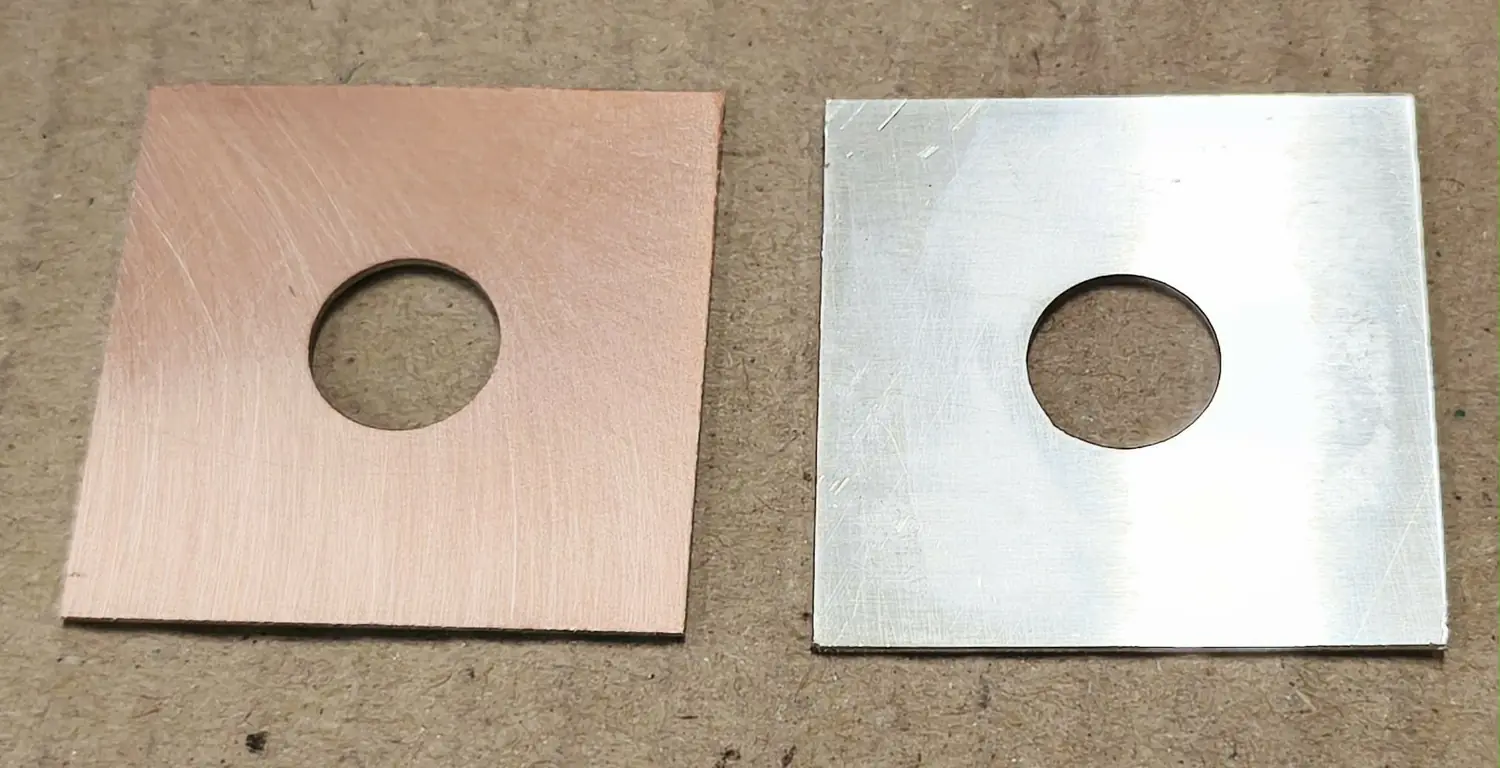
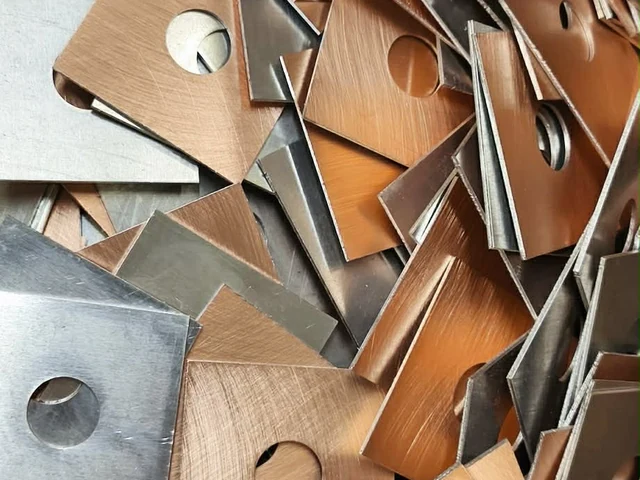
A CUPAL® bimetal plate is a square or rectangular copper-aluminium plate that sits between an aluminium busbar or terminal and a copper busbar or lug, so each metal in the joint touches only its own kind. We supply it cut and drilled to your drawing from 0.5–2.0 mm CUPAL sheet; the cutting is done by our partner. Quote within 24 hours, production in 5–10 working days.
- 0.5–2.0mm
- Plate thickness
- 30–120mm
- Common side lengths; any size on request
- 24h
- Quote
- 5–10working days
- Production
What does a CUPAL plate do?
Bolt an aluminium busbar or terminal straight onto a copper bar or lug and galvanic corrosion starts at the contact, the contact resistance rises and the joint heats up. A CUPAL plate removes that contact.
The aluminium face goes against the aluminium bar or terminal, the copper face against the copper bar or lug. Inside the plate the two metals are joined by a cold-roll-bonded, diffusion-welded interface, so on both contact faces of the joint like metal sits on like metal. The material is the same 70/30 Al/Cu bimetal (by layer thickness) as CUPAL sheet.
Common plate sizes
| Size | Thickness | Pieces per 500 × 500 mm sheet (theoretical) | Holes | Quantity (pcs) |
|---|---|---|---|---|
| 30 × 30 mm | 0.5 / 1.0 / 1.5 / 2.0 mm | 256 | None, or to drawing | |
| 40 × 40 mm | 0.5 / 1.0 / 1.5 / 2.0 mm | 144 | None, or to drawing | |
| 50 × 50 mm | 0.5 / 1.0 / 1.5 / 2.0 mm | 100 | None, or to drawing | |
| 60 × 60 mm | 0.5 / 1.0 / 1.5 / 2.0 mm | 64 | None, or to drawing | |
| 80 × 80 mm | 0.5 / 1.0 / 1.5 / 2.0 mm | 36 | None, or to drawing | |
| 100 × 100 mm | 0.5 / 1.0 / 1.5 / 2.0 mm | 25 | None, or to drawing | |
| 120 × 120 mm | 0.5 / 1.0 / 1.5 / 2.0 mm | 16 | None, or to drawing |
These are the square sizes in common use; any other size, rectangle or hole pattern can be ordered. The count is theoretical: kerf and edge margins mean slightly fewer pieces per sheet. Give the thickness and hole pattern in your enquiry.
Price: sheet price plus cutting and drilling
CUPAL plates have no list price. Material is charged at the CUPAL sheet net list price, plus cutting and drilling. The minimum is one 500 × 500 mm sheet, which in theory yields 25 plates of 100 × 100 mm.
CUPAL sheet price list →Same dimensions as these plates
| Manufacturer reference | Dimensions | From us |
|---|---|---|
| nVent ERIFLEX BMS 100 (553080) | 100 × 100 × 1 mm | CUPAL plate 100 × 100 mm, 1.0 mm |
| Teknomega PBM 100x100 (PBM1000) | 100 × 100 × 1.0 mm | CUPAL plate 100 × 100 mm, 1.0 mm |
| Elexo TUB / TDB 30–120 | 30–120 mm square, 1 mm, plain or drilled | Same size, 1.0 mm, holes to your drawing |
| BTicino 030009 | 60 × 60 mm | CUPAL plate 60 × 60 mm; thickness agreed from your drawing or the existing plate |
| BTicino 030014 / 030008 / 030010 / 030011 / 030012 | 40 / 50 / 80 / 100 / 120 mm square | Same outline |
If your specification names one of these, we supply a CUPAL plate with the same outline.
Matched by dimensions only; we do not supply the original parts. The nVent BMS plate is 0.7 mm aluminium plus 0.3 mm copper, and the Teknomega and Elexo plates are 70/30; the CUPAL plate is 70/30 Al/Cu by layer thickness, density 4.6 g/cm³.
Need a thicker plate?
The copper-aluminium transition plates on the market, from nVent, Teknomega and Elexo for example, are 1 mm thick. CUPAL plates come in 0.5, 1.0, 1.5 and 2.0 mm, which covers that use: in a bolted joint the current crosses the plate through its thickness, so the plate's job is to separate the metals, not to add conductor section. Cu-Al pieces thicker than 3 mm are a different product: explosion-welded or friction-welded transition joints, or copper-clad aluminium busbar, which replace part of the current-carrying conductor itself. We do not supply those, and we do not supply CUPAL plate thicker than 2.0 mm.
The dimensional match for the nVent BMS and BTicino 0300xx plates, with the makers' sources, is in the part-number cross-reference for other brands. How the material is built and roll-bonded is explained in What is CUPAL?
Which face goes to which bar?
The aluminium face goes to the aluminium bar, terminal or lug, the copper face to the copper bar or lug. If the plate has a hole pattern and is not symmetrical, mark on the drawing which view is the copper face, because the mirrored plate is a different part.
Assembly order is in the CUPAL installation guide; the tightening torque comes from the equipment or fastener maker, because CUPAL has no torque of its own.
Where CUPAL plates are used
In busbar joints between aluminium and copper bars in low-voltage distribution boards and switchgear. On the low-voltage terminals of cast-resin transformers, where a copper bar or lug meets an aluminium terminal; BTicino, for example, offers CUPAL plates for the aluminium terminals of its own transformers. Under the palm of a copper lug bolted to an aluminium surface, and on aluminium masts and deck fittings. Outdoors, or in damp or salt air, the cut edge must be covered, so tell us where the plate will be fitted.
Examples on CUPAL busbar transitions, dry-type transformer terminals, cable-lug joints between aluminium and copper and CUPAL on boats and masts.
Material and certificate
| Property | Value |
|---|---|
| Material | CUPAL copper-aluminium bimetal, 70 % Al / 30 % Cu by layer thickness |
| Aluminium side | AL 99.5 (Werkstoff-Nr. 3.0255) |
| Copper side | E1-Cu58 (Werkstoff-Nr. 2.0065) |
| Density | 4.6 g/cm³ |
| Electrical conductivity | 41.9 m/(Ω·mm²) |
| Material certificate | EN 10204 2.2 as standard, 3.1 on request |
Send the size or the drawing
For a square plate, the side length, thickness, quantity and the position and diameter of the holes are enough; for a more complex hole pattern, send a DXF or PDF drawing. You can attach files on the request form.
Request a quote from your drawing →Frequently asked questions about CUPAL plates
Cut to your drawing, from a single 500 × 500 mm sheet
Discs, strips, rectangles or any contour from CUPAL sheet. Send your drawing or describe the dimensions, and you get a quote within 24 hours on working days.
Get a Quote Now