Joining aluminium and copper busbars with a bimetal transition
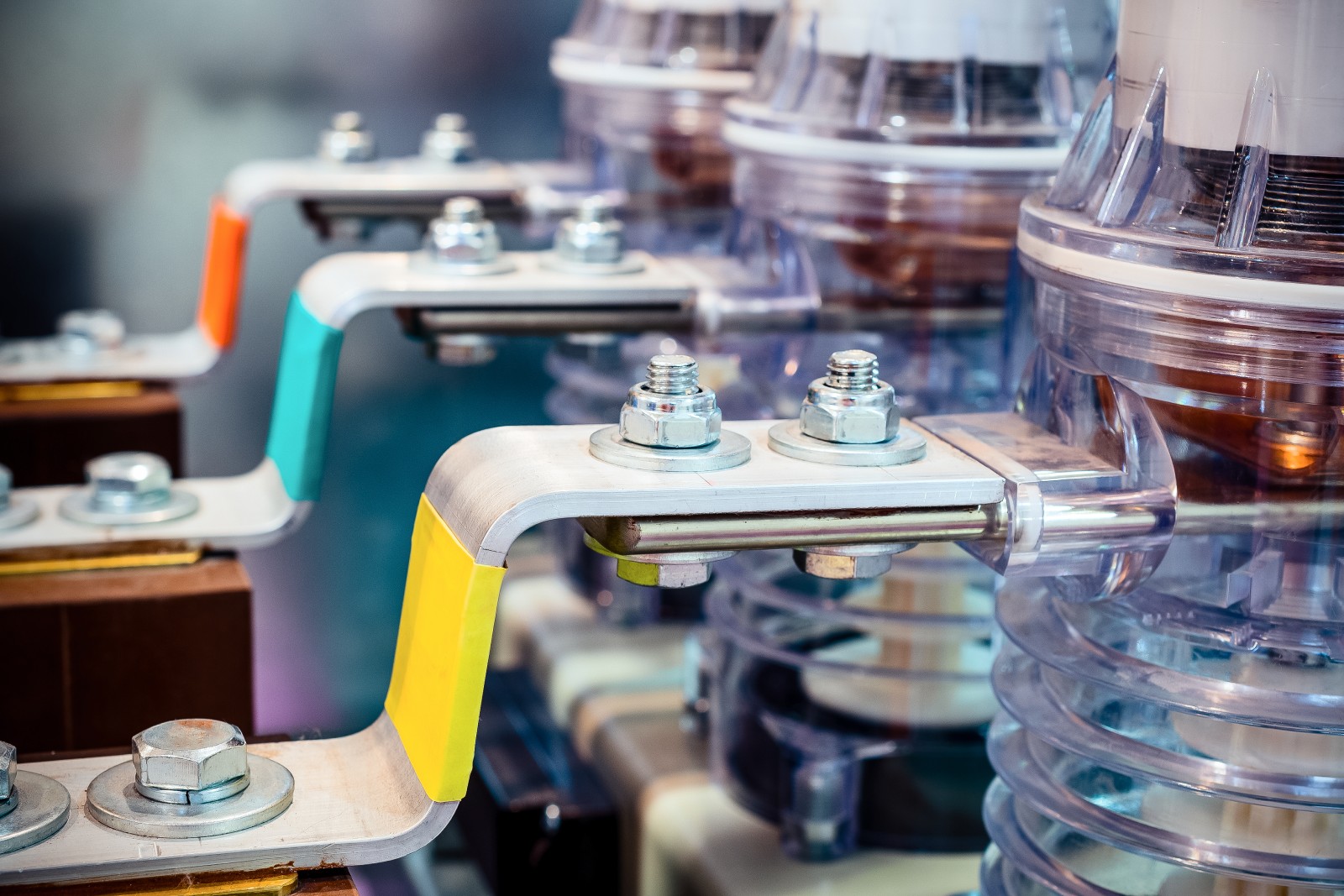
An aluminium busbar and a copper busbar in one bolted joint. A bimetal transition plate, washer or strip, cut to the existing hole pattern, keeps aluminium against aluminium and copper against copper.
Why an aluminium-to-copper busbar joint runs hot
Aluminium busbar is now common in low-voltage switchgear. It costs less than copper, weighs much less, and conducts well enough for the job. Sooner or later, though, every panel has a point where an aluminium bar is bolted to a copper one. The trouble is never the conductivity of the aluminium. It is the place where the two bars meet.
Two effects tend to get mixed up at that point. The first is galvanic corrosion. Aluminium and copper form a galvanic couple, but the cell only closes when there is electrical contact and an electrolyte at the same time: a moisture film, condensation, salt spray, hygroscopic dust. Those two conditions decide when galvanic corrosion actually starts. In a dry, closed indoor enclosure the risk is low. In a humid plant room, an outdoor enclosure, or a coastal or chemical site it is real, and over a 20–25 year service life it is hard to promise that the joint stays dry.
The second effect causes more failures in practice: contact resistance. In air, aluminium immediately grows a hard, electrically insulating oxide film (Al₂O₃). In a bolted joint that film, the creep of aluminium under load and the different thermal expansion of copper and aluminium work together. Bolt preload drops over time, contact resistance rises, the joint warms up, and the heat speeds up oxidation and creep. From there the process feeds itself.
A resistance test rarely finds this first. Thermography does: on the survey the joint is hotter than the bar next to it, although the same current flows through both. If the bar is sized for the load, the heat comes from the deteriorating contact face, not from the current.
So the fix is not a bigger busbar. It is control of the contact face.
In short
Where an aluminium busbar meets a copper one, the problem is the contact face, not the conductivity of aluminium: oxide and lost bolt preload. A bimetal transition is the established fix. CUPAL® is roll-bonded Cu-Al sheet, so aluminium bolts to aluminium and copper to copper: a washer for one bolt, strip for narrow transitions, a plate for bar-to-bar joints.
- ≥1×bar width
- Recommended overlap; the contact area decides
- 3forms
- Washer, strip or plate; the joint decides
- 5–10working days
- Production time for custom cutting
- EN 102043.1
- Inspection certificate on request
A bimetal transition plate in the busbar joint
Shapes by Hydro's overview of aluminium-to-copper busbar joints lists five established methods and describes the factory-bonded bimetallic transition plate as widely accepted as the industry standard. CUPAL is that kind of material: cold roll-bonded copper-aluminium bimetal, one sheet with pure copper on one face and pure aluminium on the other.
That makes the assembly rule simple: the aluminium face bolts to the aluminium bar, the copper face to the copper bar. Each bolted face is like metal on like metal, so no bare Al-Cu contact remains in the joint. The Al/Cu interface itself sits inside the plate, metallurgically closed. There is one exception: the cut edge, where the bond line runs out to the surface. In a dry indoor enclosure that does not matter. In an outdoor or humid joint the edge needs protecting; see the FAQ below.
Thickness is not the point. Standard 0.5–2.0 mm CUPAL sheet or strip is the right material for a transition plate. The busbars still carry the continuous current; the transition plate looks after the contact face. So size the overlap and the hole pattern, not the thickness. Rate the copper side from the DIN 43671 tables (copper busbars) and the aluminium side from DIN 43670 (aluminium busbars), as for any busbar joint.
Torque still matters. Contact pressure keeps the joint conductive, and the tightening torque sets it. Take the value from the busbar or equipment manufacturer's table; CUPAL has no torque table of its own. On a bare Al/Cu interface the aluminium creeps under the bolt preload and the two metals expand at different rates, so that joint has to be re-tightened, not just tightened. Rittal's Ri4Power catalogue tells installers to check the torque on aluminium conductors one day after installation, and then to monitor the connections with thermography or resistance measurement.
If one bolt holds the joint, typically a cable lug on a bar, you do not need a plate: the CUPAL washer, M6 to M20, gives the same like-for-like contact. If the cable itself is aluminium and not yet terminated, the right part is a bimetal cable lug, 10 to 625 mm². The cable-lug page explains when each one is the better choice.
We also supply square or rectangular CUPAL transition plates from 30 to 120 mm, drilled or plain. Beyond that, the outline is up to you: it is cut from your drawing to the existing hole pattern, so it fits without reworking the busbar section. Minimum one sheet (500 × 500 mm), quote within 24 hours, production 5–10 working days. For narrow or bent transitions CUPAL strip is the form: 500 × 40 × 0.5 mm from stock, custom widths from 40 to 150 mm. The copper face can be tin- or nickel-plated if the busbar specification calls for a coating. Certificate: EN 10204 2.2 test report as standard, EN 10204 3.1 inspection certificate on request.
For a quote we need the outline (DXF, PDF or JPG drawing), the thickness, the hole pattern and the quantity. No drawing yet? Send the busbar dimensions with your enquiry and we reply within 24 hours.
Washer, strip or plate? The joint decides
The same cold roll-bonded bimetal in three forms, plus an outline cut to your own drawing. You are not choosing a material; you are choosing the shape that fits the bolted joint. Net list prices are on the product pages.
| The joint | What you order | Size | Availability |
|---|---|---|---|
| One bolt, cable lug on a bar | CUPAL washer | M6–M20, 11 sizes, 1–2 mm thick | From stock, 2–10 working days |
| Narrow or bent transition, lightning-protection and earthing runs | CUPAL strip | Stock 500 × 40 × 0.5 mm; custom 40–150 mm wide, 0.5–2.0 mm thick | From stock; custom sizes 5–10 working days |
| Bar-to-bar lap joint from a standard sheet | CUPAL sheet | 500 × 500 mm; 0.5 / 1.0 / 1.5 / 2.0 mm | 0.5 and 1.0 mm from stock; 1.5 and 2.0 mm made to order, 5–10 working days |
| Custom outline and hole pattern, your drawing | Custom cutting | From DXF / PDF / JPG; minimum 1 sheet (500 × 500 mm) | Quote within 24 h, production 5–10 working days |
Where it is used
Four industrial points where the busbar transition is critical.
MV/LV substation: aluminium riser → copper busbar
The problem you need to solve. On the LV side of the transformer the aluminium riser meets the copper busbar. High continuous load, a daily thermal cycle, and an enclosure nobody opens for years. Bolt preload drops unnoticed and contact resistance creeps up.
How CUPAL solves it. A CUPAL transition plate between riser and busbar, cut to the existing hole pattern. Aluminium face to aluminium, copper face to copper. If the transformer terminal itself is aluminium, the manufacturers' instructions are collected on the transformer-terminals page.
Data-centre PDU branch: copper trunk → aluminium branch
The problem you need to solve. Row-level power distribution: a horizontal copper bar and a vertical aluminium branch at the rack. In continuous operation the joint sees thermal cycles, loses preload and shows up on the thermographic survey. Re-tightening a live system is awkward.
How CUPAL solves it. A CUPAL branch plate between the copper trunk and the vertical aluminium bar. Both bolted faces are like-for-like, so the joint no longer depends on the state of the aluminium oxide.
Plant main distribution: parallel aluminium conductors → copper main busbar
The problem you need to solve. In a large plant, aluminium bar or parallel aluminium conductors land on the copper main distribution. Condensation occurs in the hall, so the electrolyte that galvanic corrosion needs is present some of the time.
How CUPAL solves it. A CUPAL transition plate with a custom outline, matched to the conductor entry and the busbar hole pattern. In a humid hall the cut edge needs protecting too; mention it when you ask for a quote.
Retrofit of an old distribution board without dismantling
The problem you need to solve. In an old industrial board the aluminium riser stays, but the pasted joint keeps running hot. It has to be put right without taking the board apart.
How CUPAL solves it. A CUPAL plate cut from a drawing of the geometry measured on site, bolted in where the pasted Al/Cu interface used to be. No dismantling, no structural change.
The five established ways to join Al and Cu busbars
The bimetal transition plate is only one of them. Each works for something; the difference is how long it lasts and what maintenance it asks for.
| Method | How it works | Maintenance | When it is the right choice |
|---|---|---|---|
| Bimetal transition plate, e.g. CUPAL | Factory-bonded Al/Cu plate; each face meets its own metal | Torque check, as for any bolted joint | Joints that are hard to reach, or must last a long service life |
| Tin-plated contact faces | Tin coating on the bar; reduces oxidation but does not remove the galvanic potential | Clean at assembly, spring washers, periodic inspection | Where a transition plate will not fit |
| Bolted joint with oxide-inhibiting compound | The compound excludes moisture and limits oxide formation | Periodic inspection and re-tightening | Cheap and quick, if the joint is accessible and maintained |
| Welded bimetal transition | Explosion-bonded or friction-stir-welded Al/Cu element | None specific | Factory-built high-current bus systems; not for site fabrication |
| Crimped bimetal cable lug | Aluminium barrel crimped on the conductor, copper palm bolted to the bar | None specific, if crimped correctly | Cable-to-bar transitions, not bar-to-bar joints |
At the cable end the question is different
If the joint is not bar on bar but an aluminium cable on a copper terminal, the choice is between a bimetal lug and a CUPAL washer. Connecting copper to aluminium walks through all four joint types. For the aluminium feeder arriving in a switchgear cabinet, the table on the switchgear page gives the washer by bolt size and lug cross-section, with part numbers.
Questions from design engineers
Recommended CUPAL products
Applicable standards for this field
Knowledge base: CUPAL technical articles
9/8/2026
Connecting copper to aluminium: which part for which joint
Bimetal lug, Al/Cu splice, bimetallic washer or cut plate: which copper-to-aluminium connector fits each of five joints, in what size, with SKUs.
Read the full article →3/1/2026
Can copper and aluminium touch? Galvanic corrosion
They can touch, but where moisture reaches the joint the aluminium corrodes: 0.55 V apart in practice. What fails, and the bimetal washer that stops it.
Read the full article →2/15/2026
What is CUPAL? The copper-aluminium (Cu-Al) bimetal, explained
CUPAL is copper roll-bonded onto aluminium, 70/30 by layer thickness: one copper face, one aluminium face, for bolted copper-to-aluminium joints. 4.6 g/cm³, 41.9 MS/m.
Read the full article →